# Safary Lexicon

## 🆇 Data from X (ex Twitter)&#x20;

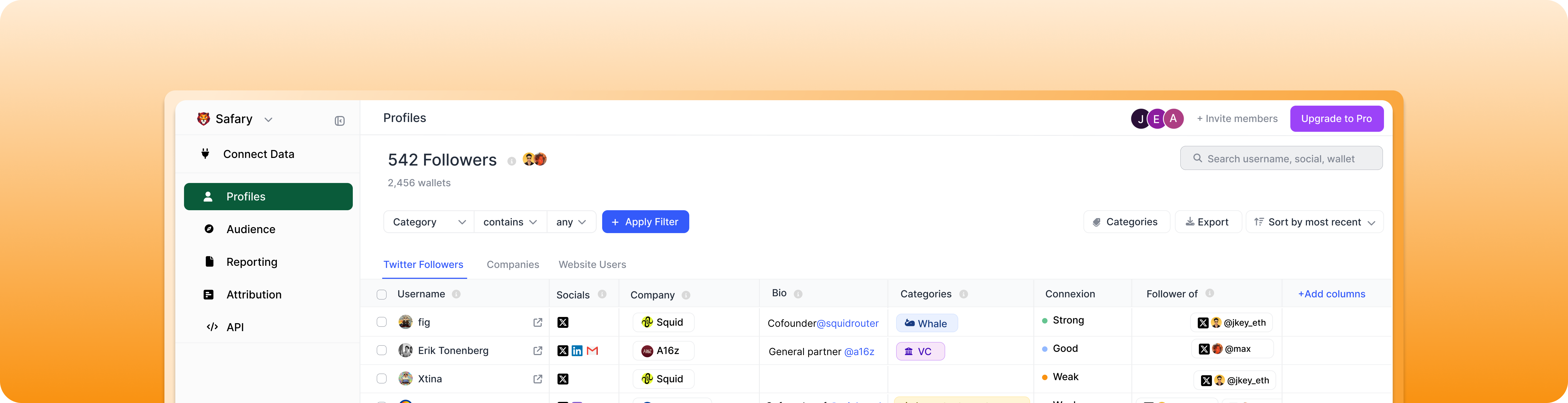
<mark style="background-color:yellow;">**Profiles :**</mark> Profiles unify the information from a user or company in your Safary dashboard. The Profiles tab is split into 3 views: Twitter followers, companies, and website users.

<figure><img src="/files/LKza1FajxvGgU9HCFFgN" alt=""><figcaption></figcaption></figure>

* <mark style="background-color:yellow;">**Twitter Followers**</mark><mark style="background-color:yellow;">:</mark> The twitter followers view shows the list of followers from an account you added to your project.
* <mark style="background-color:yellow;">**Companies**</mark> <mark style="background-color:yellow;"></mark><mark style="background-color:yellow;">:</mark>  Safary automatically detects the companies your followers belong to and populate the view "Companies"
* <mark style="background-color:yellow;">**Websites users**</mark> <mark style="background-color:yellow;"></mark><mark style="background-color:yellow;">:</mark> The "Website Users" view includes **the users** who connected to your website but also those imported by third party data sources (e.g. **Privy/Dynamic/Magic.link, Csv, Zora, Farcaster, Paragraph**).

{% hint style="info" %}
To unlock the website users, you'll need to install Safary SDK on your website. See [Add Safary script](/safary-doc-2.0/connect-data/add-safary-script.md) &#x20;
{% endhint %}

***

## 📂 Categories&#x20;

<mark style="background-color:yellow;">**Default Categories:**</mark> The categories Safary auto-generates based on user website or social activity. These include Power Users, Churning Users, Whales, Important Crypto Users, Twitter Followers, Bots, and Scams.

<mark style="background-color:yellow;">**Custom Categories :**</mark> Categories you created yourself.

***

## 🧭 Data from your Audience&#x20;

<mark style="background-color:yellow;">**Total audience**</mark> : Your total audience includes the followers of your brand Twitter account and your website users. We analyze and provide a rating of your audience to help you improve it and prove your audience quality to partners and exchanges.

<figure><img src="/files/tCBVWD0sKRcGPbgidzp1" alt=""><figcaption></figcaption></figure>

<mark style="background-color:yellow;">**Brand X account:**</mark> This is your company account that was specified during onboarding.

<mark style="background-color:yellow;">**Audience rating (e.g., "AAA"):**</mark> We rate your audience similar to financial assets, ranging from "CCC" to "AAA," based on qualitative and quantitative analysis. This includes evaluation of user growth, quality, and mentions.

<mark style="background-color:yellow;">**Important Crypto User (ICU):**</mark> Users with significant credibility in the crypto space who are either well-known, have a substantial following, or are influential builders. Our ranking specifically prioritizes builders and active crypto professionals, distinguishing us from other platforms.

<mark style="background-color:yellow;">**Bots and scams:**</mark> Users identified as fake accounts. These should not constitute a large percentage of your audience.

<mark style="background-color:yellow;">**Mindshare:**</mark> This metric determines your visibility on crypto Twitter by analyzing your brand account's mentions per minute and their quality.

{% hint style="info" %}
Full certified audience report is available on the <mark style="color:purple;">PRO</mark> plan only
{% endhint %}

***

## 💻 Data from your website &#x20;

<figure><img src="/files/b2TWiz1e9Mo4e357OU4M" alt=""><figcaption></figcaption></figure>

<mark style="background-color:yellow;">**Visitors :**</mark> A visitor is someone who has visited your website at least once since you added the Safary script. A visitor can have one or multiple sessions, and each session can contain one or more visits.

{% hint style="info" %}
When we discover that two visitors have connected the same wallet, we merge them into a single user. This process may slightly reduce the total number of visitors in our tracking.
{% endhint %}

<mark style="background-color:yellow;">**Users**</mark> <mark style="background-color:yellow;"></mark><mark style="background-color:yellow;">:</mark> A **visitor** becomes a "User" when he authenticates to your app through a **wallet** or any mode of **connection** (form or social login events). Users are unique — they can have multiple wallets, and multiple social profiles — found from their wallets.&#x20;

<mark style="background-color:yellow;">**Signup rate (%) :**</mark> <mark style="background-color:yellow;"></mark> The percentage of visitors who becomes users after authenticated in your product (by connecting a wallet or signing up).&#x20;

<mark style="background-color:yellow;">**Event :**</mark> A specific **action** completed by your user (ex: 'swap').

<mark style="background-color:yellow;">**Wallets :**</mark> All the wallets from a specific user. We differentiate wallets by:

<table><thead><tr><th width="193">Wallets type</th><th>Definition</th></tr></thead><tbody><tr><td><strong>Total wallets</strong></td><td>Total wallets linked to a single user (through website connection AND social accounts)</td></tr><tr><td><strong>Connected wallets</strong> </td><td>Wallets who only got connected to the website since the safary script was added</td></tr><tr><td><strong>Imported wallets</strong></td><td>Wallets imported through Zora mints, CSV Import, Paragraph subscribers, Farcaster subscribers, Farcaster casts, CSV upload, Privy, Dynamic or Magic.link</td></tr><tr><td><strong>Customer wallets</strong></td><td>Wallets who only interacted with the protocols (swaps, deposits) among the ones connected to the website</td></tr></tbody></table>

***

## 🤑 On-chain Data

{% hint style="info" %}
Total wallet balances and assets are refreshed once a month <mark style="color:purple;">for PRO Customers</mark> only.
{% endhint %}

<mark style="background-color:yellow;">**Total wallet balance ($):**</mark> The **sum** of all wallet balances belonging to a user, including staking positions.

<mark style="background-color:yellow;">**Assets:**</mark> Assets owned across the portfolio or all wallets of a user.

<mark style="background-color:yellow;">**Protocol positions:**</mark> The positions (staking, deposits, liquidity provided, or borrowed) on other protocols (e.g., Uniswap, Lido). When possible, we even provide the APY of other protocol pools. This helps identify which solutions your users are using.

***

## 🚀 Attribution Data

<figure><img src="/files/MWfNZdZZxdXWmaYEn70U" alt=""><figcaption></figcaption></figure>

<mark style="background-color:yellow;">**Channels/source:**</mark> The origin of your users' or visitors' first visit.

<mark style="background-color:yellow;">**First click attribution model:**</mark> Safary uses a "first click" attribution model. This means the source is determined by where a user first came from. Users retain this source tag throughout their lifetime, even when they return through different channels. First click attribution works well for crypto because users typically visit websites multiple times before making decisions.

<mark style="background-color:yellow;">**Campaign:**</mark> In Safary, a campaign begins with a generated link. These links can be placed in ads, content, newsletters, or given to referrals.

{% hint style="info" %}
Crypto users often hesitate to click links directly on Twitter. We recommend embedding links within content outside of Twitter.
{% endhint %}

<mark style="background-color:yellow;">**Campaign Budget**</mark> <mark style="background-color:yellow;"></mark><mark style="background-color:yellow;">($)</mark>: The total budget allocated for your campaign. For paid ad campaigns, this amount divided by the number of incoming users determines the Cost of User Acquisition.

<mark style="background-color:yellow;">**UTM:**</mark> UTM sources and campaigns are tracking tags that Safary detects in the attribution tab to identify specific traffic sources from your links.


---

# Agent Instructions: Querying This Documentation

If you need additional information that is not directly available in this page, you can query the documentation dynamically by asking a question.

Perform an HTTP GET request on the current page URL with the `ask` query parameter:

```
GET https://safary-1.gitbook.io/safary-doc-2.0/safary-lexicon.md?ask=<question>
```

The question should be specific, self-contained, and written in natural language.
The response will contain a direct answer to the question and relevant excerpts and sources from the documentation.

Use this mechanism when the answer is not explicitly present in the current page, you need clarification or additional context, or you want to retrieve related documentation sections.
